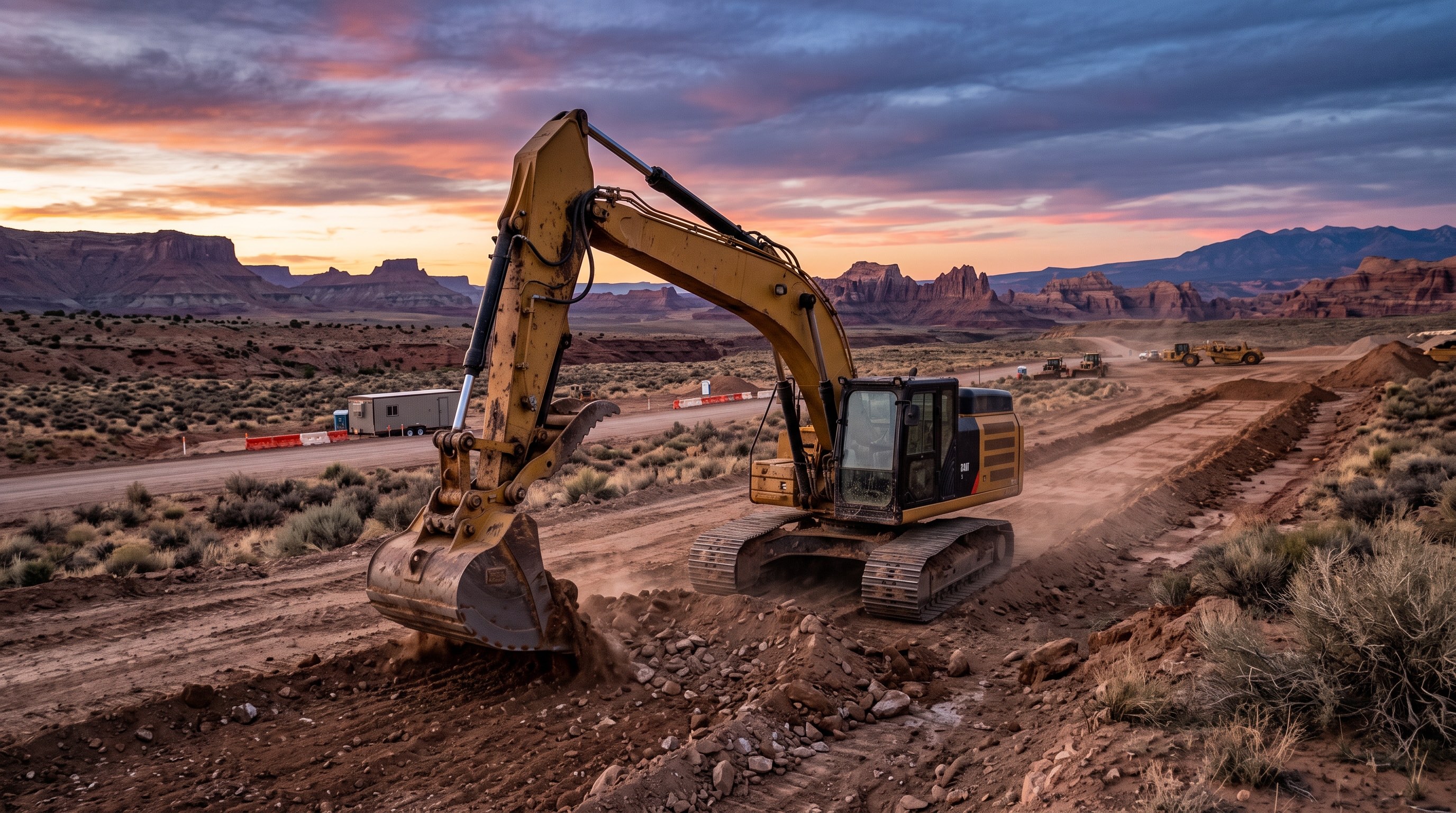
A utility trench looks like the simplest kind of dirt work — a straight line in the ground — but the details that don't show later are the ones that matter: the depth, the bedding under the pipe, the way it's backfilled, and the Blue Stakes locate that keeps you from hitting a line already down there. This guide covers how utility trenching is done right in Tooele, how frost and rocky ground change it, what it costs, and how to vet a crew. Our on-site estimates are free.
Depth, bedding, and backfill: what actually matters
Every buried line has its own rules, and a good trench respects them. The three things that decide whether a trench is done right are depth, what the pipe sits on, and how it's put back:
- Depth. Water lines have to sit below the frost line so they don't freeze; sewer and septic lines are set to a steady downhill slope so they drain; power and gas have their own required cover. One trench often carries several utilities at staggered depths and separations.
- Bedding. Pipe rests on a bed of sand or screened material, not on rock, so a sharp cobble doesn't wear a hole in it under pressure — a real risk in Tooele's rocky ground.
- Backfill and compaction. The trench is filled in compacted lifts so it doesn't sink into a trench-shaped rut across your yard or driveway a year later.
| Line | Why depth matters |
|---|---|
| Culinary water | Below the frost line so it can't freeze |
| Sewer / septic lateral | Deep enough to hold a constant downhill slope |
| Power & gas | Required cover for safety and code |
| Irrigation / secondary | Below tillage and winter freeze in use |
The cheap trench is the one dug shallow, laid on rock, and pushed back in loose — invisible on day one and a problem by the next hard winter.
Frost, rock, and Tooele Valley trenches
Two local realities shape trenching here. The first is frost: Tooele Valley winters get cold enough that a water line dug too shallow will freeze and split, so culinary water lines are buried below the frost line — generally around three to four feet of cover in this area, per your city or the county. Get that depth wrong and you find out on the first hard cold snap.
The second is the ground itself. The same rocky, gravelly, caliche soil that makes foundation work slow makes trenching slow too, and it is the reason bedding matters so much — you don't want a pressurized water line resting on a cobble. On rural lots around Erda, Stansbury Park, and out toward Grantsville and Rush Valley, trenches also tend to run long: a well or a septic drainfield can sit a good distance from the house, and a septic lateral has to hold a steady downhill slope the whole way. Plenty of valley properties also run a secondary (irrigation) line separate from culinary water. Every one of those digs starts the same way — with a free locate through Blue Stakes of Utah (811), which state law requires a few business days before any excavation.
What proper utility trenching includes
A trench done right follows these steps — and the bargain quote tends to skip the bedding or the compaction:
- Blue Stakes locate. A free 811 call marks existing utilities before digging — always, no exceptions.
- Dig to depth and slope. The trench is cut to the right depth for each line, and to a consistent slope for anything gravity-fed like sewer or a septic lateral.
- Bedding. Sand or screened material is placed so the pipe rests on a smooth bed instead of on rock.
- Lay and inspect. Lines are placed with proper separation, and the trench is left open for the inspection your permit requires before it's covered.
- Backfill in lifts. The trench is filled and compacted in layers, often with warning tape above the buried lines, so it doesn't settle.
- Restore the surface. The ground, driveway, or landscaping over the trench is put back close to how it was found.
Leaving the trench open for the inspector is the step that protects you — covering a line before it's signed off can mean digging it back up.
What does utility trenching cost in Tooele?
Trenching is usually figured by the linear foot plus the connections at each end, and depth, soil, and length all move it — a short, shallow irrigation run and a long, deep sewer lateral through caliche are very different jobs. National figures like HomeAdvisor's trenching cost data give a rough frame, with rocky ground at the high end.
| Job | Typical range* |
|---|---|
| Basic trenching (per linear foot) | $8 – $25 / ft |
| Water line (dig, lay, backfill) | $1,500 – $5,000+ |
| Sewer / septic lateral | $2,500 – $8,000+ |
| Rock / caliche digging | Added labor & equipment |
| Bedding & imported backfill | Per yard as needed |
*Ballpark ranges for planning only. Rock, deep or long runs, bedding import, and surface restoration run higher; a short, shallow trench in soft ground runs lower. Only a written on-site quote for your run applies.
The lowest bid per foot can cost more in the end if it skips bedding or compaction — a line laid on rock, or a trench that settles into a rut, is a repair waiting to happen. For a real number on your run, call (435) 660-5063 for an on-site provider estimate.
How to vet any trenching crew (including us)
Before you book a trenching crew, ask:
- Do you always call Blue Stakes before digging, and do you wait for the locate?
- How deep will you set my water line for frost here, and how do you slope a sewer or septic run?
- Do you bed the pipe in sand or screened material over rocky ground?
- Do you leave the trench open for inspection before backfilling?
- Do you backfill in compacted lifts and restore the surface?
A crew that talks confidently about depth, bedding, and inspections is one that has been through it. Hesitation on any of those is a reason to keep calling.
Tooele trenching and utility questions, answered
How deep does a water line need to be in Tooele?
Deep enough to stay below the frost line so it can't freeze, which in this area generally means around three to four feet of cover, set by your city or the county. Sewer and septic lines are dug by slope rather than a fixed depth — deep enough to keep a steady downhill fall. The crew digs to the local requirement for each line.
Do I really have to call Blue Stakes?
Yes — Utah law requires a free 811 locate before any digging, and it's there to keep you from hitting a buried gas, power, water, or communication line. You or the crew call a few business days ahead, the utilities mark their lines at no charge, and only then does the trench get dug. The operators we connect you with never skip it.
Why does the pipe need bedding?
Because Tooele Valley's ground is full of rock and cobble, and a pressurized line resting on a sharp stone can eventually wear through. Bedding the pipe on sand or screened material gives it a smooth base and is cheap insurance against a leak you'd otherwise have to dig up later.
Can you trench a long rural run to a well or septic?
Yes — long runs are common on acreage around Erda, Stansbury Park, and Rush Valley, where a well, septic tank, or drainfield can sit well away from the house. A septic lateral has to hold a consistent downhill slope over the whole distance, which is exactly the kind of grade a trenching crew watches for.
Will the trench settle and leave a rut in my yard?
Not if it's backfilled properly. A trench filled in compacted lifts stays put; one pushed back in loose settles into a shallow trench-line over the next season. Proper compaction and surface restoration are part of a real trenching job, not an extra.
Which areas do you serve?
Tooele and the surrounding Tooele Valley — Grantsville, Stansbury Park, Erda, Lake Point, and Rush Valley. Trenching often follows site prep and grading on a new build, and the crews we connect you with handle the whole sequence.